
Royal Danish Air Force Merlin Deployment to RAF Valley, August - September 2017
In August and September 2017, myself and Jack were very lucky to be granted permission to come to RAF Valley, Anglesey, to cover the deployment of the crews of 722 Squadron Royal Danish Air Force and two Leonardo Merlin Mk.512 helicopters, in order to produce an article for Air Forces Monthly. Here is the full article that appeared in print in late 2018. Special thanks to everyone at the RDAF, Royal Air Force and Air Forces Monthly qho made this one possible. Without further ado;
Nordic Wizards - On exercise with the Royal Danish Air Force's 722 Squadron in North Wales
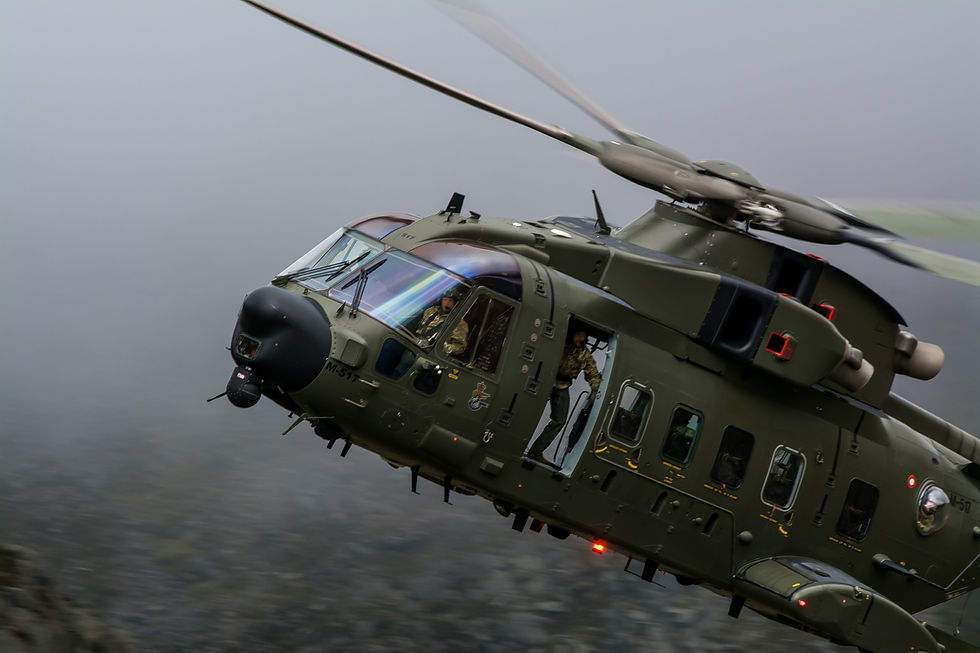
On any normal weekday, if there ever was one in the scenic tranquillity of Anglesey and the dramatic majesty of the Snowdonia Mountain Flying Training Area ( MFTA ), one could hope to see a variety of UK Based military aircraft, namely but not confined to the Bell Griffin HT.1 helicopters and the BAE Systems Hawk T2 aircraft from RAF Valley, some Typhoons or Tornados from Coningsby and Marham respectively, or if lucky possibly a couple of F-15s from RAF Lakenheath. The odd Chinook from Benson or Odiham can turn up, as well as perhaps some Hercules from Brize Norton or an Osprey from Mildenhall.
During late August and early September of 2017 however, that same scenery played host to some very welcome and rare visitors from Scandinavia, in the form of 2 Agusta-Westland ( now part of Leonardo Helicopters ) AW101 Merlin Mk.512 and their crews of No. 722 Squadron of the Royal Danish Air Force, based at Karup, Midtjylland. Arriving on Tuesday 29th August to RAF Valley, and having flown through the series of valleys more frequently known as the ‘Mach Loop’ on their way to Anglesey, the crews took a day off to prepare for their training and acclimatise for the Welsh weather they would be subjected to during the next two weeks of intensive and through training.


Formed in 1951, originally in the transport role, 722 Squadron reformed in 1956 as a Search and Rescue ( SAR ) unit. Various aircraft have been used in the squadron’s history from the beginning of it’s role as a SAR unit, and these include the Sikorsky S-55 helicopter when the unit was reformed, PBY Catalina flying boats, Aerospatiale Alouette III and Sikorsky S-61 helicopters, finally culminating with the AW101 Merlin Mk.512 that the unit operates today. The Sikorsky S-61 arrived in 1965, and ended it’s service in 2010 when the AW101 became fully operational in the SAR role. It had less range than the Merlin Mk.512, but has been noted to have had less downwash. Furthermore, the Merlin is a larger helicopter, allowing the crew to operate more effectively whilst on tasking, and is one of the biggest praise points about this helicopter over it’s predecessors. Finally, the Merlin is a much smarter aircraft, giving it the ability to operate in poor conditions and bad weather, something the S-61 would have had very significant problems in. Not only is this much safer for the crews, but it is a blessing for those who require the helicopter’s assistance.


The squadron’s home base of Karup was built in World War Two by the Germans, who occupied the country at the time. It is the main base for helicopters in the Royal Danish Air Force, and is more commonly known as the Helicopter Wing Karup. The squadrons based there along with 722 Squadron, who fly the SAR and Tactical Troop Transport ( TTH ) AW101 Merlin Mk.512, are 723 Squadron, flying another of Leonardo’s aircraft from it’s history in the Westland Super Lynx Mk.90B, which operate alongside Sikorsky SH-60B Seahawks, and 724 Squadron, operating the National Response and Army Observation helicopters, in the form of the Aerospatiale AS350 Fennec. Coupled with the flying squadrons based there, there are basic training, support units and the air force’s tactical staff.
The primary role of the Merlins operated by Denmark is a combination of Search and Rescue and the support of the Danish Special Forces, with a further supplement to the Combat Search And Rescue operation should it be required.


The Royal Danish Air Force operates 7 SAR and 7 TTH Helicopters, and all are part of the country’s National Emergency Procedure. This states that if one aircraft breaks down or suffers a fault and has to make an emergency landing, they can simply call in another Merlin at any given moment’s notice. 3 AW101 Merlins are on a 24 hour standby at any one time, with a 15 minute readiness period maintained constantly by the groundcrews and aircrew. As part of this emergency response initiative, 3 further Merlins will always be in deep, heavy maintenance, ensuring that a constant rotation of aircraft to the frontline unit is achievable, and it is hoped that the helicopters will always be in prime condition, so that if the procedure was needed to be called upon, there would be no issues with regards to availability and serviceability of the aircraft, which could limit the response times to a disaster or national emergency. Coincidentally, one Danish Merlin is actually in Britain at this time, being rebuilt after encountering a little mishap during operations in Afghanistan.
The AW101 Merlin normally has 18-19 seats, but in times of emergency, where the aircraft needs to be used in the MEDEVAC, CSAR or SAR role, those seats can simply be removed and replaced with one stretcher and medical equipment, with 2-3 litters being placed on the floor of the helicopter. It takes a crew of 7 in this configuration, consisting of 2 Pilots, Aircraft Commander, Doctor, Winchman, Winch Operator and a loadmaster/medic. The Merlin Mk.512 that 722 Squadron operates is designed mainly as a SAR helicopter, with the upgrades and enhancements to the systems over the standard version reflecting this. Among the plethora of systems included on board is the RDR-1600 Search and Weather Radar, for locating ships and navigating in poor weather conditions. This is especially useful given Denmark’s location, with the North Sea being known for it’s extensive fog banks and difficult, harsh conditions. The aircraft has extended range due to an extra fuel tank fitted to it, an essential when on a SAR operation where the aircraft may need to loiter on a scene, such as if a person has been seen to fall into the sea, or if a crew needs winching off a sinking vessel. An Obstacle Warning System will alert the crews to objects such as wires, power lines, radio masts or terrain in their path, allowing the crews to take action and avert a catastrophe. This is particularly useful in bad or poor weather conditions , and also in mountainous regions where the risk of low cloud and hill fog may suddenly descend on a crew. The cabin also has a different design to other Merlin variants, as each member of the 7-strong SAR crew has their own exits in case of an emergency. This common egress system is being retrofitted by Leonardo to the Royal Navy’s Merlin HC.4 and HC.4A helicopters, as well as the Italian Navy’s brand new HH-101 Caesar aircraft.

Denmark acquired it’s full complement of 14 AW101 Merlin helicopters in 2006, with the SAR variant achieving it’s Full Operational Capability later the following year. However, during 2007 the 6 TTH helicopters were sold to the Royal Air Force, with the Ministry of Defence purchasing 6 new build aircraft for Denmark to reciprocate them for this move. One of the crew members, and a contact for us for the visit and article, Kris ( not his real name ) was actually trained in the RAF, as part of the deal with the Ministry Of Defence supplying the Royal Danish Air Force with the new build Merlin helicopters. It stated that No. 60 Squadron, based at RAF Shawbury, Shropshire, was to train the crews destined for the RDAF Merlin force for 12 months, and then they would progress onto RAF Benson’s 28 ( AC ) Squadron for a 10 month conversion course. After converting onto the Merlin, Kris stayed on with 78 Squadron, and deployed twice to Afghanistan during his time with the unit. Interestingly, in Denmark young adults are conscripted to join the armed forces. In his case he spent 8 months with the Royal Guards of the Danish Army, based in Copenhagen. After this, and upon deciding the armed forces was their calling in life, those who wish to make a career in the Armed Forces will apply to whichever branch they favour the most. In his case Kris applied for the Royal Danish Air Force, and was successful in passing all training, rising to eventually becoming one of the aircraft commanders on the deployment to Wales. He has 1600 flying hours altogether, and 1400 are on the AW101 Merlin Mk.512.

The aircraft that the Royal Air Force acquired from Denmark were designated as the Merlin HC.3A, to reflect the differences between that and the original Merlin HC.3 the RAF operated at the time. A new squadron to take them was formed at RAF Benson, that being No. 78 Squadron. As part of the initiative by Joint Helicopter Command ( JHC ) in 2012, those aircraft have been transferred to the Royal Navy’s Commando Helicopter Force, and after modifications to the aircraft, including the ability for the aircraft’s blades and tail to be folded for easier storage on the aircraft carrier or other vessels such as a Type 45 Destroyer, strengthened gear and fast roping equipment akin to the Italian Navy’s HH101 Caesar, will become the Merlin HC.4 and HC.4A respectively. No. 28 (AC) and 78 Squadrons both disbanded upon transfer of the helicopters to the Royal Navy, with the former reforming in 2015 to become the Support Helicopter Operational Conversion Unit for the Chinook and Puma HC2 helicopters of the Royal Air Force.

The purpose of 722 Squadron’s deployment to RAF Valley and subsequent training in the Snowdonia MFTA was a simple one – mountain flying. As one of our contacts “Henrik” ( again, not his real name ) stated during an interview with us, the reason they had chosen RAF Valley and the Snowdonia MFTA was because that although Denmark has a vast amount of hills and drumlins, none are over approximately 400 metres in height, or to that matter require extensive crew co-operation to safely navigate and negotiate. To be given a bigger challenge, one that is designed to prepare and build a crew for operations or deployments to regions where this kind of flying is a necessity, a new location was required to conduct this essential training in. The mountains of Snowdonia in North Wales presented that notable training environment to hone, build, learn and practise the skills that every helicopter crew must master to fully prepare them for the trials and tribulations that military flying is known for, whether it be on exercises during peacetime, or on deployment in mountainous, harsh areas such as to Northern Afghanistan in 2014 and 2015 when 3 Merlins of the Royal Danish Air Force deployed to Mazar-E-Shariff.
Another reason they had chosen the Snowdonia MFTA to train was that a few years ago a British Royal Air Force exchange officer from RAF Benson, Oxfordshire, notified the crews at Karup of the area during a tour in the country, and having explained how it has enhanced their own flying capabilities, not to mention RAF Valley being so close by for logistical and basing reasons, it was identified as the perfect place to prepare for a type of flying their own country could not provide for them. The Snowdonia MFTA is in the northern half of the Snowdonia National Park, with the area split into 5 further sections, labelled from Victor through to Zulu in the Phonetic Alphabet. The areas encompass and include some of the most dramatic and well known mountains in Snowdonia, and all present great opportunities for aircrew to practice flying in tight, confined environments such as mountains. Having met up with one of the Danish crews on deployment at RAF Valley during planning for their sortie the next day, it was decided by all that we were to head to section Whisky, which is the furthest north, and stretches from just south of Llanfairfechan on the North Wales coast, and as far south as Capel Curig. In this area, there was a corrie bowl called “Ffynnon Lloer”, or “Spring of the Moon”, situated between Pen Yr Ole Wen and Carnedd Dafydd, two imposing mountains that formed a tight amphitheatre, perfect for helicopter aircrew to conduct training in tight and confined conditions. It was also ideal for getting some dynamic images of the exercises in question, and having agreed with the crews on the location, we headed up the next morning to see what the day could bring.


Arriving bright and early that morning, there was a bank of cloud surrounding the summit of Carnedd Dafydd and Pen Yr Ole Wen, which gave a slight concern that the sortie may have been scrubbed at the last minute. Thankfully, after about 2 hours of waiting, along the ridgeline, there came the unmistakable sound of engines and the sight of a Merlin helicopter. The crew dropped in to perform a quick check and go around of the landing area, and also to get some bearings on the hazards associated, such as the scree, the lake, and also to plan what kind of landing they would be attempting on the terrain. In this case, they chose a pinnacle landing, where one or two sets of landing gear would be on the terrain, but not all. This is designed to ensure the crew are proficient in the essential skills required to operate in dangerous or restrictive areas. This can be seen if they have to drop off or pick up ground forces or personnel in high terrain, or conduct a medical evacuation in areas where there is no possible landing zone. The crews have to work together to fully ensure the safe operation and conduct of the manoeuvres, as in this situation any loss of communication between the crew could spell disaster for all. The two loadmasters will be constantly checking for obstacles, persons in the area, and any other hazards. They will be relaying the information to the aircraft commander and the pilots, keeping them updated with all that goes on behind and in the areas the pilots cannot see, so that safe, effective execution of the mission or exercise can take place. In a pinnacle landing, as the pilots gently lower the aircraft, the loadmasters will be calling out height references, and if there are any hazards the pilots cannot see, such as boggy, false ground or a rock just sticking out that could damage the aircraft and sensitive parts such as radio receivers, lights and communication equipment. This is called Voice Marshalling, and is given so that the whole crew is aware of the situation in and around the aircraft, and have no confusion on how to handle the aircraft in hazardous situations such as mountain landings. It is also particularly useful in confined areas such as forests and woodlands, and also for dust landings, where the potential for a heavy landing or worse in “brown-out” conditions, where the pilots and crew cannot see any reference points used to safely land a helicopter or use as a reference for height and vertical speed due to dust and sand blown up by the downwash, causing nothing but a fog of brown colour enveloping the aircraft and crew.

When landing in those conditions, any false move may result in a catastrophic incident, such as the aircraft rolling over, suffering serious damage to a hard landing, or even worse with the aircraft totally wrecked and the potential for serious injury or more. Given that the helicopters are used in troop transport and special forces support, Combat Search And Rescue and perform operations of Search And Rescue in conjuction with coastguard and other maritime and mainland authorities, it makes sense to practice the manoeuvres that may be required in a real life situation at any chance the crews can get. By extensive drilling and co-operation between all crews on the deployment, it will strengthen the team as a unit, and deliver a capability that the Danish Armed Forces can utilise in any situation that presents itself, whether in peacetime or on operations.

The environment of Snowdonia is very different to the terrain back in Denmark, the crew and personnel will take any opportunity to train in unforgiving, challenging and somewhat alien conditions, to prepare them for any eventuality, such as the aforementioned deployment in 2014 and 2015 to Mazar-E-Shariff in Afghanistan. They will practice it year upon year, so that no training or currency for the crew is wasted, and by building on the experience they have had in Snowdonia during their time on deployment, they can take it back to Karup and teach other crews on the principles of mountain flying, and the hope is that these type of deployments may become regular, so Danish Merlins, and other helicopters of European air arms, may become a sight not so unfamiliar in Snowdonia in years to come.
Once this exercise was complete, the crew went and headed back to base at RAF Valley, and we progressed down to a location on the ridgeline of Pen Yr Ole Wen, in the area known as the Ogwen Valley, or for those who conduct low level flying and photography, the A5 Pass. The corner presented an ideal chance to get another few photographs of the crews on another training exercise. This time, in the late afternoon, it was conducted in Whisky and X-Ray, the latter enclosing Tryfan and the Glyders, another area that presented a challenge for the crews training that day. It’s steep walls and corrie bowls enabled some intensive exercises to be conducted, which concluded after a timeframe of around 2 hours in a low and expertly flown pass at the corner where the Ogwen Valley turns into the Nant Ffrancon Valley, leading out to Anglesey.


Our time with the crews was therefore up, and so we headed back to HQ with a sense of what I’m taking the crews had also had during their time over in Snowdonia – “Mission Accomplished”. We feel so privileged to have been given the opportunity by all who were involved in making this idea a reality. Myself and Jack would like to extend our enormous, incredible thanks to Group Captain Nick Tucker-Lowe DSO MA MCMI RAF, Station Commander of Royal Air Force Valley, Squadron Leader Dave Williams, Media and Communications Officer at Royal Air Force Valley, SAC Chris Thompson-Watts, of the Royal Air Force Valley Photographic Section, HQ Air Command, Royal Air Force High Wycombe, Brig. (AF) Lars Hedemark of the Helicopter Wing Karup, our contacts and the crews of 722 Squadron Royal Danish Air Force who were deployed to RAF Valley in August-September 2017, and The Danish Embassy in London. Without your help, we could not have done this endeavour, and this report would not be happening without your grateful assistance. We really are in debt to you all.
Our Flickr album is located here - https://www.flickr.com/photos/67846102@N03/albums/72157678463538398
This was a huge privilege for us to cover, and it is something we very much would appreciate doing again in the future. Fingers crossed post COVID-19 things will get to a point where we can do this again!
Until next time,
Tom & Jack
JTW Aviation Images
Comments